
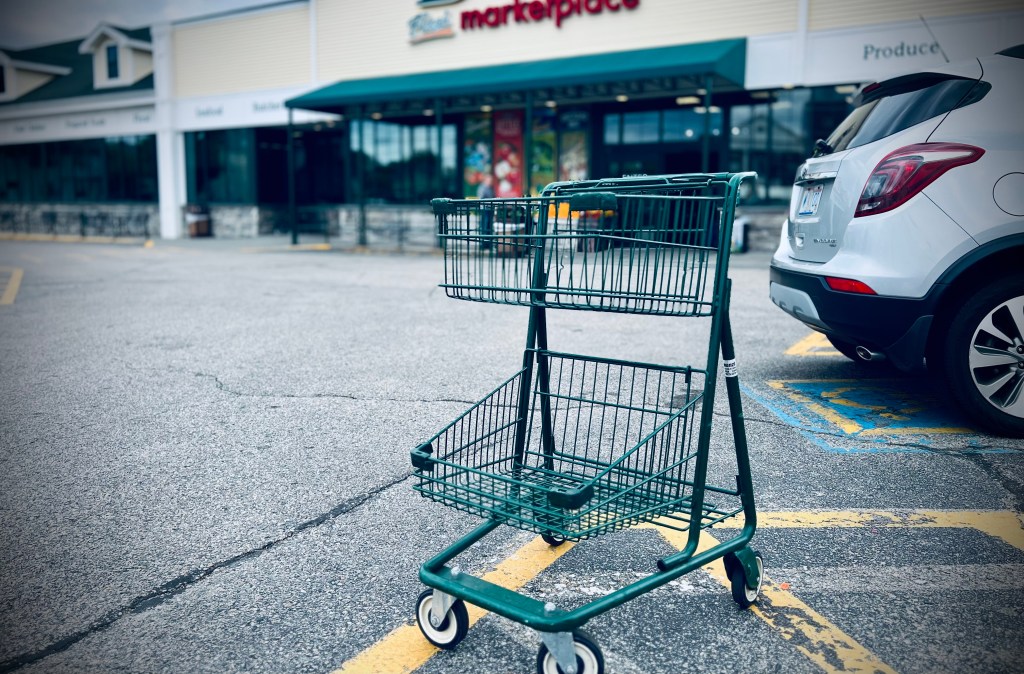
Shopping carts come in all shapes and sizes. But given the choice, smaller is almost always better.
You’re looking for the small cart. Not a big cart. Not a basket. The one in the middle, with two compact hampers, one atop of the other, and a wheel-base about the size of a welcome mat. No matter what you’re shopping for, this is the cart you prefer. It’s easy to push. It turns on a dime. And every time you use one, you’re able to fit all your groceries, with just enough space for some wadded reusable bags.
The small basket fits your minimalist personality. But it also makes you think about shopping carts in general.
À la Cart
It’s hard to imagine anyone inventing the shopping cart, much less a time before they existed. Yet the vehicles we recognize today, with their ability to “nest” together, were the brainchild of one Orla Watson in the 1940s, although this led to a convoluted patent dispute over the next few years. By the 1960s, these carts were a mainstay in supermarkets across the U.S.
Dave’s Market
You want to say that Dave’s Fresh Marketplace is your favorite supermarket in Rhode Island, but that doesn’t do this place justice; Dave’s is easily your favorite grocery store of all time, a locally owned chain with reasonable prices, an understated loyalty program, and spotless aisles. The best part: Each Dave’s location has a fleet of small shopping carts—nearly as many as large shopping carts. You like the small ones, of course, but you also feel that shopping carts have a psychological effect: If you walk into a Walmart (for example), and the only carts available are the size of a Cadillac Eldorado, you feel a subconscious obligation to fill it with stuff. By all appearances, Dave’s doesn’t want to trick you into buying things you don’t need, and that’s one reason you keep coming back. You also appreciate its slogan: “Dave’s is different.”
Carriage?
One morning, many years ago, you entered a supermarket and stopped just before the entrance. You may have been adjusting your gloves, or checking your phone—you can’t quite remember, but for some reason, you paused, just in front of the sliding doors.
A woman exited the store, pushing a cart. She picked up her bag and murmured, “Carriage.” In her accent, it sounded like “CAH-rich.”
At first, you thought she was talking to herself. She spoke in a low “inside voice,” the way you might repeat something in order to memorize it. But all at once, you realized she was talking to you; in New England, many people refer to shopping carts as “carriages”; and she wasn’t just saying the word aloud—she was asking a question: Would you like to take my shopping cart?
Years later, you still think of this moment. You had just moved to Rhode Island, after two decades away from New England, and this felt like a kind of welcoming-back: The mumbled phrase, the lack of intonation, and the strange lingo. And even today, you feel a compulsion to pronounce it “CAH-rich.”
Cool Kāto
Japan is famous miniaturizing things: bonsai trees, compact cars, and floor desks, among other everyday items. Most Japanese cities are gigantic and densely built, so private space is at a premium; to Americans, family apartments can look like dorm rooms. So it’s no surprise that many people in Japan use very small shopping carts—known as kāto (カート)— which are even nimbler than the ones at Dave’s Fresh Marketplace. The baskets are often removable, as well, so you can park your cart in a corner and pick out vegetables with ease. You wrote a whole article about them for Explore, and you feel pangs of envy, when you see pictures online.
To the Candy Aisle, Jeeves
By the end of today, millions of children will have ridden around in a shopping cart. Their parents will lift them off the floor and fit their legs through two square openings, which are designed for this purpose. These toddlers will lean against a rubber-coated handle, face-to-face with their designated adult; they will travel through the store, backward, with no control over their movement.
This is a major rite of passage in the United States, something so routine that most people never think about it. The child seat dates back to the 1950s as well, and one decade later, they were standard. You still have vague memories of this ritual, and the never-ending desire to reach out and snatch something—anything—from the shelf.
You also notice all the electric carts, which are essentially motorized wheelchairs, for shoppers with mobility challenges. Americans tend to judge each other for using them, especially when the rider is obese or carrying an oxygen tank. But this is the kind of innovation you appreciate: Simple tech, designed to help anyone feel normal and included.
Panther on the Lam
When you were a kid, you watched the The Pink Panther cartoon series as part of your Saturday morning lineup. One 1969 episode, “Carte Blanched,” is permanently stuck in your memory: A trench-coated character known only as “The Inspector” pushes his groceries home in a shopping cart. An omniscient narrator speaks directly to The Inspector, informing him that he has effectively stolen the cart. Horrified by his crime, The Inspector tries every method he can think of to hide, disguise, or destroy the pilfered property, but nothing works. This is the kind of downward spiral that the Pink Panther series specialized in—with a nonstop jazz riff in the background—and in the 40 years since you first saw this short, you have never once left a supermarket without thinking of it.
 You Are Here