
Electric vehicles won’t save the world. But they will make you think about it.
Nothing presses people’s buttons like an electric vehicle. Early prototypes date back to the 1830s, and turn-of-the-century models like the Electrobat nearly scored mass appeal. Yet gas-fueled combustion engines always won out. In the 1990s, powerful people went to great lengths to quash EV technology, as chronicled in the 2006 documentary Who Killed the Electric Car?
Even today, as EVs proliferate around the world, the public is still prickly about them. Protesters set fire to Tesla dealerships; Big Oil insists on fossil fuels. “EV corridors” reinvent highway systems; the U.S. pummels Iran with rockets—and not, we can assume, to encourage the sales of Kia EV9s.
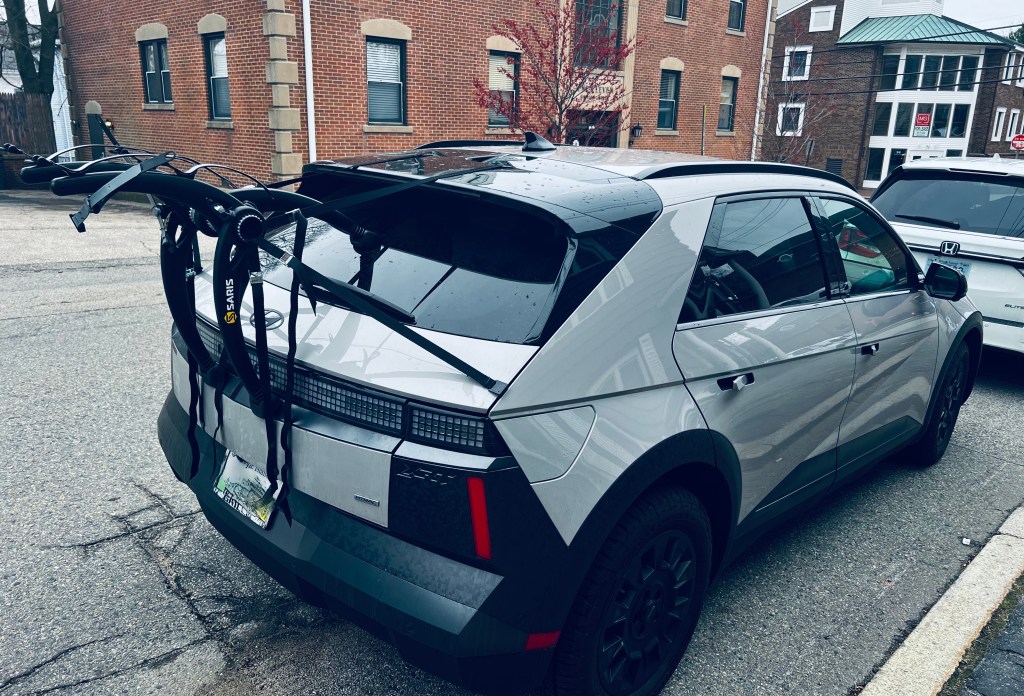
But you’ve tried one anyway. By Earth Day 2026, you will have driven your Hyundai Ioniq 5 for a full seven months. This is your first EV, an anything-goes experimental lease you would never have considered in your leaner youth. How do you describe your relationship with this car? In short, “it’s complicated.” But you’ve learned six solid lessons—lessons you would only have gleaned from firsthand experience.
1. EVs will not save the world.
An electric vehicle is still a vehicle, and it doesn’t change the nature of motorways. A million EV drivers will still clog the interstate, battle for parking spots, and run down pedestrians. EV batteries require rare earth elements like cobalt and lithium (as do phones and computers). And if you ever want to feel hopeless about the future of humanity, spend a few minutes seeing where these resources comes from.
Note that this video was produced by the Wall Street Journal. Not exactly red-diaper babies over there.
2. It feels like you’re driving a giant iPad.
Like most EVs, the Ioniq 5 has a digital control panel, along with an array of physical buttons. To navigate, a GPS map will flicker to life; when you signal right or left, a little video will appear behind the steering wheel, revealing your blind spot. A magical “bird’s eye view” video pops up every time you park, and you still have no idea how this is possible. All the displayed information is useful, such as how many miles of charge you probably have (with “high,” “low,” and “average” figures), or the posted speed limit versus your current speed. But you’ve hoped to reduce your exposure to backlit screens, and an EV is a massive step backward. Even now, after all these months, the screens are overwhelming.
3. The safety features are hilarious
If your car starts to drift on the highway, it will automatically course-correct. The first time this happens, it’s a hair-raising surprise, like KITT wrestling control from Michael Knight. The car will also stop, suddenly, if you seem to approach an obstruction too fast. These features might very well save your life, but the car also beeps at almost any external stimulus; parallel parking throws the car into a noisy panic (your skills in this area probably don’t help). Goofiest of all is your bike rack: If you mount your bicycle on the trunk, the Ioniq 5 will assume something is positioned directly behind you and refuse (at first) to reverse at all.
4. It drives like a dream.
The absence of oily parts is a big relief, especially for someone who hates to drive in the first place. The car is eerily quiet—you’ve sometimes forgotten to turn it off and simply walked away. Acceleration is buttery-smooth. The Ioniq 5 pays close attention to your driving habits, and if you seem at all distracted, the car will gently suggest you take a break (and shows a graphic of a cup of coffee). You can’t believe it, but you almost enjoy getting behind the wheel. If anything, the car’s sleek design and high-tech atmosphere make it stressful to operate; a gas-powered car feels expendable, just an everyday machine you will eventually replace. A fender-bender in the Ioniq 5 would keep you up at night for a month.
5. You notice them everywhere, now
Like a word you’ve heard for the first time, or the name of a band you never listened to before, you suddenly spot EVs everywhere. It’s like half your city went out and bought an Ioniq 5. The same goes for charging stations: You actually notice them in lots and garages. A house you’ve passed a hundred times has its own little tower and cable on the edge of its driveway, and you think, “Was that there the whole time?”
6. You actually think about your energy use.
EVs aren’t exactly convenient to power, and that’s what you like most about them. Even the “fast charger” tends to take 20 minutes or so, and you spend this time milling around a Shell station, some 10 miles from your house. The process is slow and multi-step; you can’t just shove a nozzle into a gas tank and start pumping. You dread this cumbersome ritual, so you keep a close eye on your miles. You question, again and again, whether any given trip is worthwhile. Traditional cars are different: You’ve been conditioned your whole life to simply fill your tank with gas, no matter what the price per gallon, and then you drive with abandon, because there’s always a service station nearby. This is the real power of the EV in the 2020s: moderation is key. EVs won’t end climate change or disinfect the air, but just driving less in general? Not a bad start. And you really could use that cup of coffee.
 You Are Here